
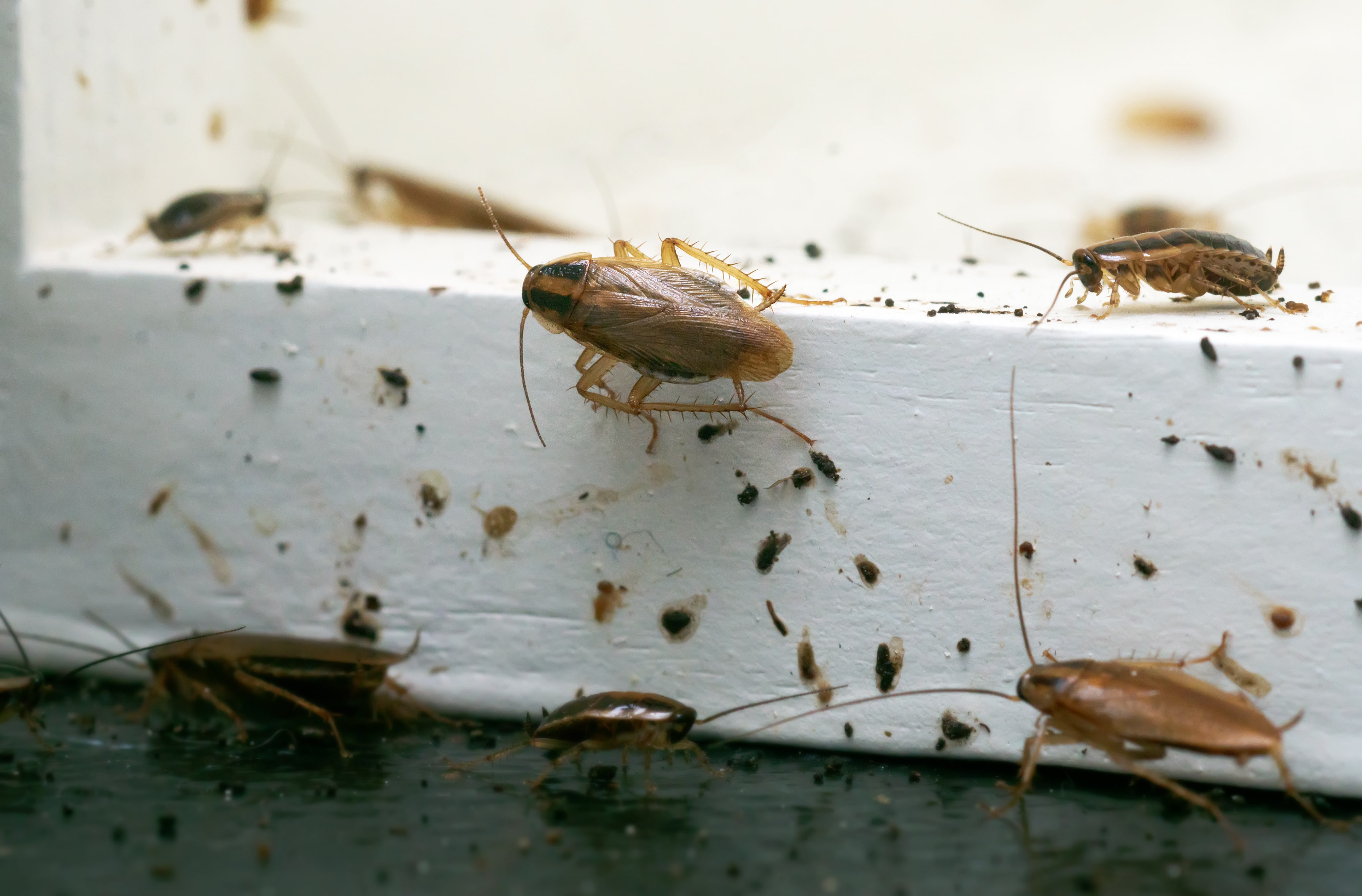
How to Keep Cockroaches Out of Your Alaska Kitchen
September 14, 2026 5:05 pmWhen the first hard freeze locks up Alaska roads and nighttime lows drop into the single digits, most homeowners assume every unwanted insect died along with the mosquitoes. That assumption misses one detail: forced-air furnaces, insulated crawlspaces, and warm utility chases turn the inside of a home into a stable, food-rich environment no matter what the thermometer reads outside. Since 1965, Pied Piper Pest Control has watched the same pattern repeat every autumn across Alaska, and learning how to keep cockroaches out of your Alaska kitchen starts with understanding why the cold never actually reaches them.
Why Alaska’s Winters Don’t Clear Out Kitchen Pests
Cockroaches cannot survive Alaska’s subzero outdoor air, and that part of the myth is accurate. What it leaves out is that a modern, heated Alaska home, with its forced-air furnace, insulated crawlspace, and utility pipe chases running warm water through interior walls, holds an indoor microclimate that rarely drops below 65 to 70 degrees. From a cockroach’s perspective, a heated kitchen in February looks no different than a warm coastal city in July.
Where the Warmth Hides in Subarctic Construction
- Insulated crawlspaces, heating vents, and utility pipe chases stay warm enough for cockroaches to remain active and reproduce straight through the winter months.
- Utilidors and shared heating tunnels, a common construction feature in many Alaska communities, create direct, heated corridors from a building’s foundation into its warmest rooms.
- Cockroaches are strongly drawn to starch, paper, and cardboard, materials common on pantry shelving and in stacked delivery boxes, a behavior pattern documented by the University of Alaska Fairbanks Cooperative Extension Service.
The Winter Die-Off Myth, Debunked
The belief that a hard freeze resets a home’s pest pressure every season is one of the most persistent myths homeowners repeat to themselves. A furnace running around the clock maintains interior temperatures well within the range a cockroach needs to feed, hide, and reproduce, so the outdoor climate simply stops mattering the moment they cross the threshold. Sealing entry points before the ground freezes, watching for activity through the winter, and addressing moisture issues once the thaw begins is a far more reliable rhythm than waiting for a visible sighting.
Cockroaches are nocturnal and built for concealment, favoring the narrow gap behind a refrigerator, the inside of a cabinet wall, or the shadowed back corner of an under-sink cabinet. A population can build quietly in those spaces for weeks before anyone notices a single insect, which is exactly why timing matters as much as the method.
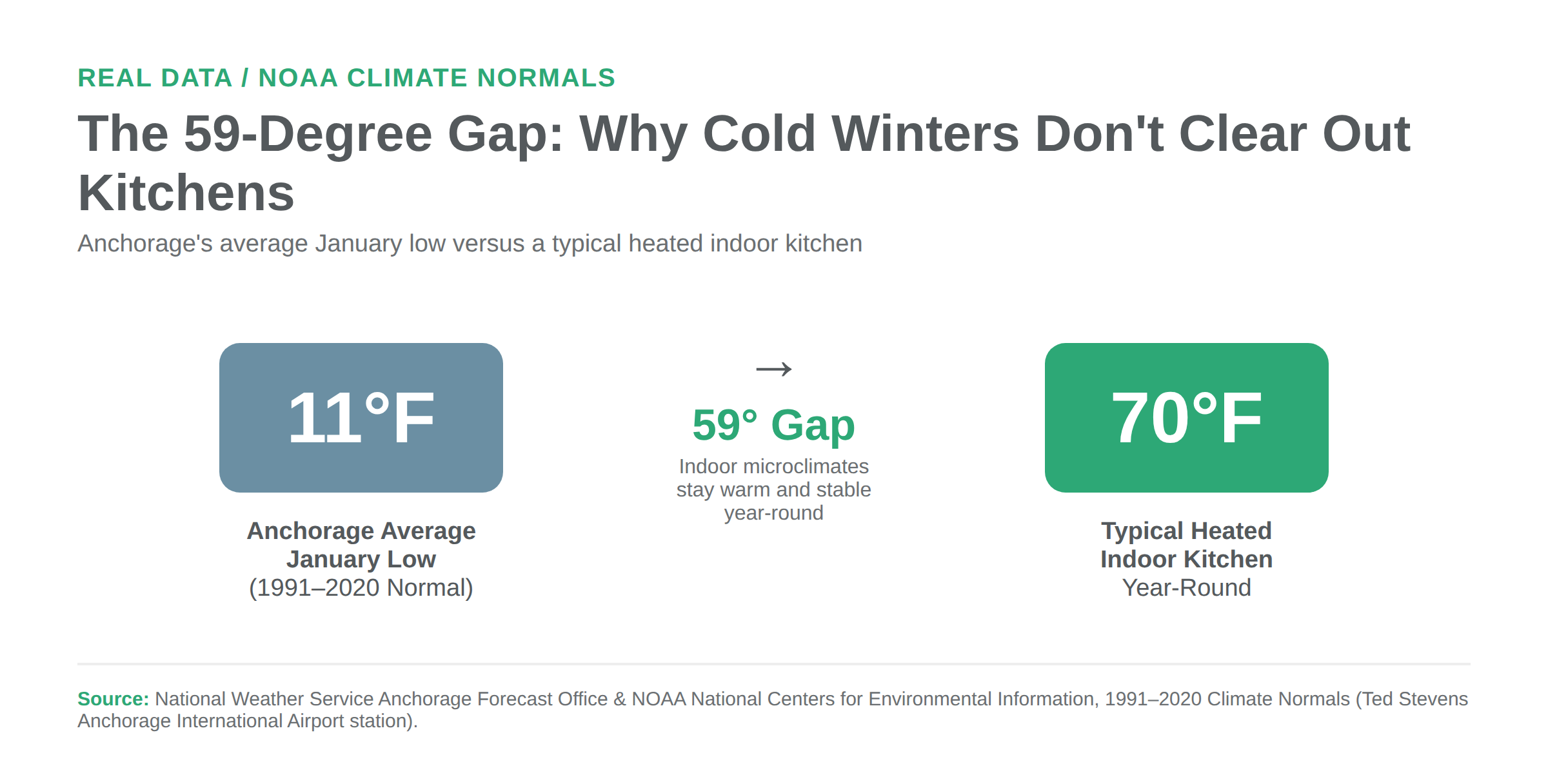
An 11-degree winter morning outside and a 70-degree kitchen inside are two different worlds separated by nothing more than a wall and a furnace, according to climate normals from the National Weather Service. That 59-degree swing is the entire reason a subzero month outside has no bearing on what happens behind your stove.
Common Kitchen Entry Points in Alaska Homes
Utility Lines and Plumbing Penetrations
- Pipes entering a kitchen from a crawlspace or utilidor create a direct pathway from a building’s foundation into its warmest rooms.
- Gaps around under-sink plumbing are among the most frequently overlooked entry points; a gap the width of a pencil is wide enough for a cockroach to pass through.
- Packing copper mesh tightly around the pipe, then finishing with a bead of silicone caulk, creates a barrier that holds up through repeated freeze and thaw cycles.
Crawlspaces and Foundation Vents
- Alaska construction frequently uses crawlspaces to buffer a structure from ground movement, and those same spaces trap heat and moisture, conditions that make them hospitable to cockroaches.
- From a crawlspace, cockroaches migrate upward through wall voids and emerge at kitchen baseboards, often with no visible exterior entry point at all.
- Crawlspace hatches and foundation vents deserve a close look each fall; a deteriorated screen or an unsealed hatch frame is a simple fix before the ground freezes solid.
A gap around a heating duct or water line that looks minor to the eye is, proportionally, a wide-open corridor for a cockroach moving along a wall void. Physical exclusion works continuously once it is in place and needs no reapplication, which makes it one of the most cost-effective steps in winterizing a kitchen against seasonal activity.
The Real Way to Keep Cockroaches Out of Your Alaska Kitchen
Preventing cockroaches in a subarctic kitchen comes down to three habits working together: removing what attracts them, drying out what they need to survive, and sealing the routes they use to arrive. None of it requires a drastic intervention, just a seasonal rhythm suited to how Alaska homes are built and heated.
Eliminate Food Sources and Attractants
- Store dry goods such as flour, rice, oats, and other starches in airtight glass or plastic containers rather than their original paper or cardboard packaging.
- Wipe down countertops daily and sweep behind heavy appliances regularly; crumbs and grease residue build up in those gaps faster than most people expect.
- Break down and dispose of cardboard boxes and paper grocery bags soon after unpacking, since cardboard left near a kitchen for even a few days becomes an unnecessary attractant.
Manage Moisture and Humidity
- Fix leaky under-sink pipes and dripping faucets as soon as they’re noticed; standing water is a more reliable draw for a cockroach than food in a dry indoor environment.
- In a kitchen with poor ventilation or one adjacent to a damp crawlspace, running a dehumidifier through the winter can meaningfully reduce the conditions that support activity.
- Wiping down the sink basin before bed removes a consistent overnight water source and targets one of a cockroach’s most significant biological weaknesses.
Daily Habits That Keep Cockroaches Out of Your Alaska Kitchen
- Clean under and behind the refrigerator and stove, where food particles and warmth tend to collect.
- Store pet food in a sealed container overnight instead of leaving a bowl out.
- Take out kitchen trash nightly and rinse the bin on a regular schedule to clear residue.
- Seal gaps in baseboards and cabinet backing with a quality silicone caulk as soon as they appear.
Setting Up an Early Warning System
Strategic Trap Placement
Sticky traps placed in dark corners, behind appliances, and under sinks catch individual insects before a population has a chance to establish itself in a wall void or cabinet space. Monitor those spots regularly and note which locations show the most activity; that pattern tells you exactly where to focus sealing and sanitation effort next.
A Simple Monthly Monitoring Routine
Check trap contents once a month and swap out anything coated in dust, since a dusty trap loses its adhesive effectiveness and stops providing reliable information. Keeping a short log, even a note on your phone, of what you find and where means that if a professional assessment does become necessary, you can hand over a clear picture of the activity pattern instead of starting from zero.
Found something on a trap? Call Pied Piper Pest Control at (907) 344-2538 or stop by 2440 E 88th Ave Ste A. A technician will conduct a site-specific inspection and build a plan that’s safe for your family, pets, and the wildlife around your home.
Why Clean Kitchens Still Get Cockroaches
Hitchhiking Pests and Alaska’s Freight Supply Chain
Cockroaches often arrive by hitchhiking in grocery bags, shipping boxes, or beverage crates rather than crawling in from outside. Because Alaska relies heavily on freight shipping, goods travel through multiple distribution points before reaching a store shelf or a front door, and a pest can board the chain at any one of those stops. Finding a cockroach in a kitchen says nothing about anyone’s housekeeping; it reflects a supply-chain reality that touches even the most meticulous households across Alaska.
Shared Walls in Multi-Family Buildings
In duplexes, townhomes, and apartment buildings, cockroaches migrate between units through shared wall voids and utility chases without ever crossing an exterior wall. Shared heating ducts and plumbing runs create connected corridors a pest can travel freely, which is why coordinated, building-wide prevention tends to outperform a single unit acting alone.
The Health Stakes of Kitchen Cockroaches
Pathogens and Food Contamination
Cockroaches can carry organisms including E. coli, Listeria, and Salmonella, all linked to food poisoning, according to the U.S. Environmental Protection Agency. Those pathogens transfer to countertops, utensils, and uncovered food as cockroaches move through a kitchen overnight, frequently without leaving any visible trace behind. Sanitizing food-prep surfaces with an appropriate disinfectant, not just wiping them down, adds a meaningful layer of protection in any kitchen where activity is a concern.
Allergens and Respiratory Health
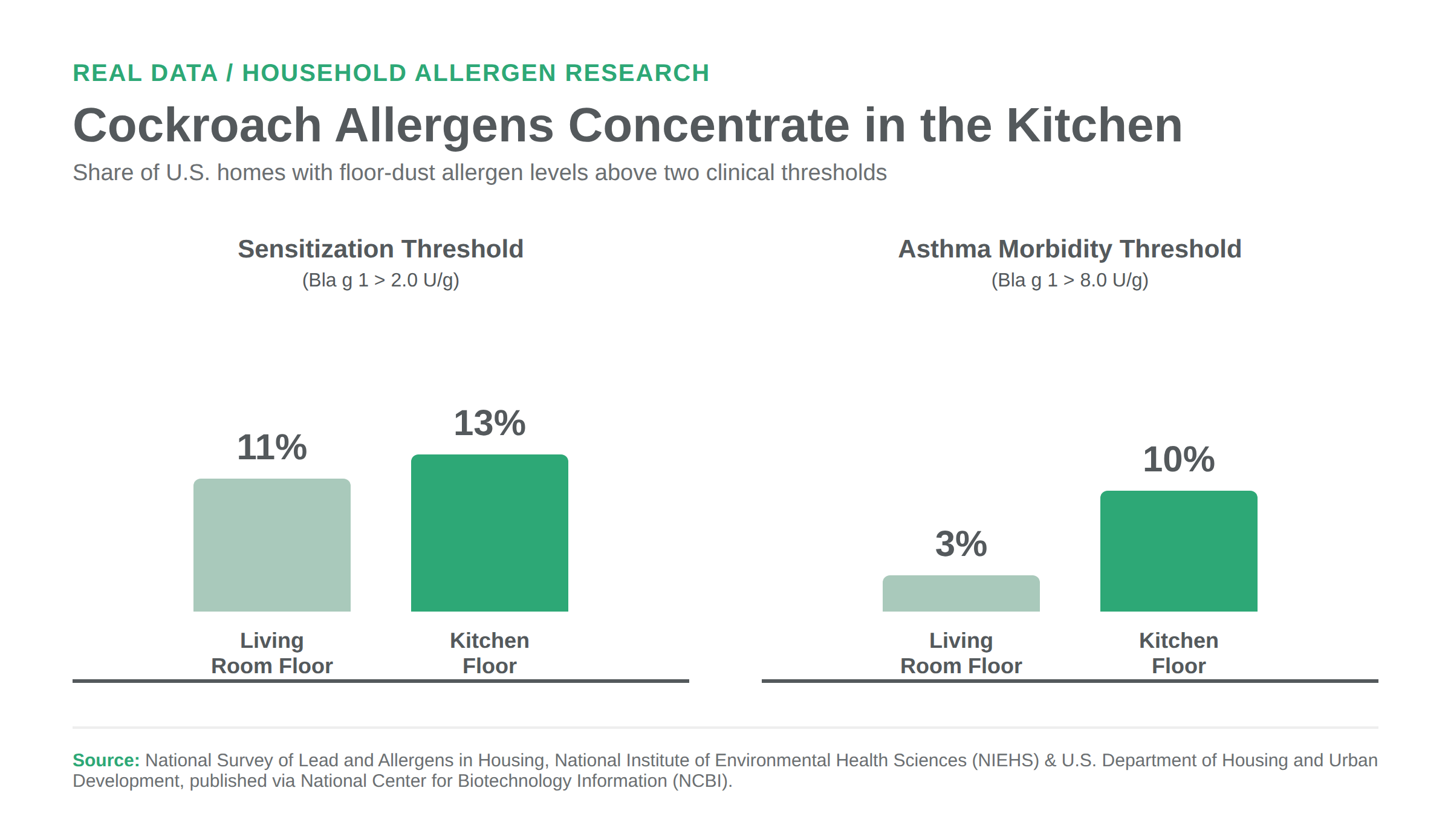
Shed skins, droppings, and body fragments from cockroaches are a documented source of allergens that can trigger asthma attacks and allergic reactions, a pattern confirmed in a national household study published through the National Institute of Environmental Health Sciences. Kitchen floors carry higher allergen concentrations than living room floors precisely because that’s where food, warmth, and moisture overlap most. Debris from cockroaches can also become airborne and degrade indoor air quality over time, which matters even more in a home with limited winter ventilation. Managing kitchen pests is a family health matter as much as a housekeeping one, and the respiratory effects can be significant for children and anyone with an existing sensitivity.
Cockroach Prevention, By the Numbers
| Data Point | Figure |
|---|---|
| Americans who report taking preventive pest measures at home | 36% |
| Homes with no history of cockroach infestation that still carry significant allergen levels in dust | 1 in 5 |
Sources: National Pest Management Association / Harris Poll and American Lung Association.
Retail contact sprays can neutralize a visible insect on contact, but they don’t reach the population nesting deeper in a wall void, and some repellent-based sprays cause cockroaches to scatter into adjacent rooms rather than eliminating the source.
“Annual ant prevention treatments have kept our home problem-free for years. When we had a wasp nest that needed removal, the technician was polite, professional, and thorough.”
Neil Falconer
Why Professional Treatment Works Where Store-Bought Sprays Fail
The Limits of Retail Sprays
- Retail sprays target only the insects you can see, leaving the population nesting in wall voids, cabinet interiors, and crawlspace connections completely undisturbed.
- Improper chemical application carries real safety risk for families and pets, especially in food-prep areas where residue can linger on surfaces.
- Many over-the-counter products are repellent-based, meaning they push cockroaches away from the treated spot rather than eliminating the source, a result that often relocates activity to a bedroom or bathroom.
The Professional, Site-Specific Approach
A technician performing professional cockroach control starts with a detailed inspection to identify the entry points, moisture conditions, and food sources driving activity in a specific home. Targeted, non-repellent baits placed along cockroach travel routes get carried back to the nesting site, creating a transfer effect that addresses the population at its source instead of just its perimeter. The emphasis stays on long-term prevention and physical exclusion, proofing a structure so the underlying conditions get resolved rather than just the symptoms.
A Local Partner for Long-Term Prevention
Six Decades Serving Alaska
Pied Piper Pest Control has served Alaska since 1965, which means six decades of direct experience with the seasonal shifts, construction styles, and pest pressures specific to this state. Cockroach prevention is only one piece of that work; browse the full range of pest control services to see how the same seasonal, site-specific approach applies to everything from ants to wildlife.
Customized, Site-Specific Plans
Every home gets a plan built around its own construction, layout, and seasonal risk factors, since a one-size-fits-all approach doesn’t hold up in a state with this much geographic range. That same attention extends across the rest of the household through ongoing year-round residential pest control, so a kitchen stays protected as conditions shift from freeze-up through breakup and into summer.
Frequently Asked Questions About Kitchen Cockroaches
Why shouldn’t I squish a cockroach?
Squishing a cockroach can release bacteria and allergens into the air, potentially triggering a reaction in someone with asthma or a sensitivity, and it can also spread egg cases that stick to a shoe or the floor.
What smell do cockroaches hate the most?
Cockroaches tend to avoid strong scents such as peppermint oil, lavender, eucalyptus, and citrus, since these interfere with their sensory receptors. Those scents may discourage activity temporarily, but they won’t resolve a nesting population already established in a wall or cabinet.
Does running the heat or AC keep cockroaches away?
Cooler air can discourage cockroaches somewhat since they prefer warm, humid conditions, but it won’t manage an active population if food and water are still available. In Alaska this is rarely a practical control method anyway, since heating runs for most of the year regardless.
What is a cockroach’s biggest weakness?
Consistent moisture. A cockroach can survive for weeks without food but will die within a few days if completely deprived of water, which is exactly why keeping a sink and its pipes dry overnight is one of the most effective daily habits available.
What kills cockroaches immediately?
Contact-based aerosol insecticides neutralize a cockroach on contact, but they only affect the individual insect hit and do nothing for a population nesting deeper in a wall void or beneath a cabinet.
Keeping cockroaches out of an Alaska kitchen comes down to three things working together: sanitation that removes what attracts them, physical exclusion that closes their routes in, and monitoring that catches activity early. None of it requires a drastic intervention, just attention and a seasonal rhythm that fits the way Alaska homes are built and heated. Ready to get ahead of it before the next freeze sets in? Reach out to schedule an inspection, or call (907) 344-2538.
Categorised in: Insect Control
This post was written by Pied Piper Team